
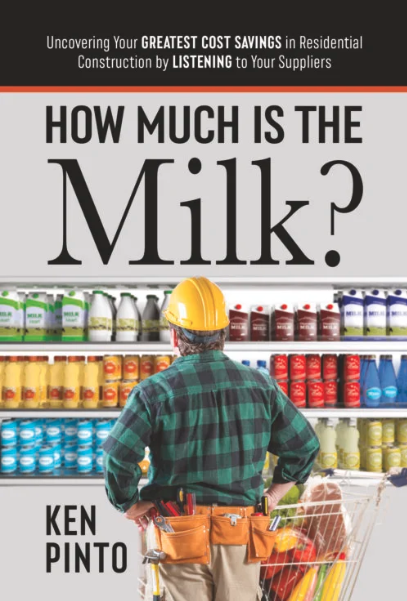
Click the cover to look inside
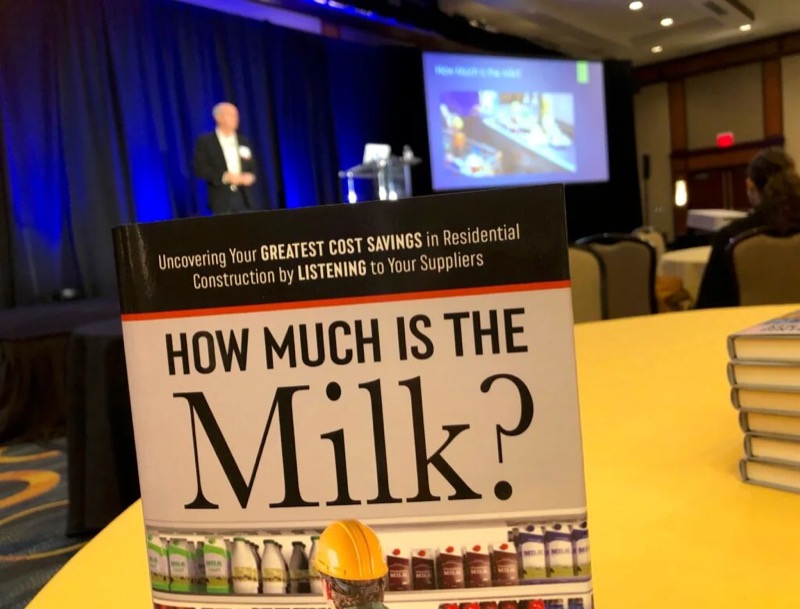
How much is the milk?
Uncovering your greatest cost savings in residential construction by listening to your suppliers.
One supply chain. Four ways to stop paying for silence.
Everyone in the channel is on the same team. The book shows each seat what to ask, and what to answer.
Builders
The questions that lower costs, raise capacity, and shorten cycle time.
Subcontractors
Get heard again, and get paid for the ideas you’ve been sitting on.
Distributors
A little collaboration with builders removes pain on both sides of the counter.
Manufacturers
Two signals, SKUs and Date Needed, end the inventory guessing game.
On the back of the truck
A full section of the book, exactly as Ken wrote it.
Chapter 3 · Last Mile Logistics
On the Back of the Truck
Parker and I marched into the drywall distributor’s office, gigantic smiles on our faces, ready to spring a great idea on them. They were going to love it, and we would walk out as heroes who saved the day, increasing revenue to the drywall distributor and reducing costs to us. Win-win. We couldn’t wait to see the look on their faces. When was the last time a builder did something like this for them, huh? This was probably the first time. We were so excited.
We sat down with the owner and general manager (GM) of this successful, privately-owned drywall distribution company. They had been in business for over twenty years and had nine locations, and we were sitting in their largest branch, the only one with a conference room. We sat down, opened our folders, displayed the spreadsheets and charts we had prepared, and stated the case for having them put ceramic floor tile on the back of their drywall trucks. After a long, detailed presentation, laying it all out, we leaned back, smiled at each other, and waited for the accolades to begin.
They looked at each other, looked at us, looked at each other again, looked at us, and in unison, said, “No.”
Our detailed proposal included renting a small area of their warehouse to store a buffer of floor tile, not too much. I think we started with about fifteen square yards and offered a fair price per square yard. The buffer acted as a cushion for when the construction schedule fluctuated, allowing for a continuous flow of materials to the site when ordering another full truck from the tile manufacturer was not feasible, plus it relieved some anxiety for those nervous about this new process. Over time, and as we all became confident in the new process, buffer inventory would be reduced to about a three-week supply. We used historical data to decide which colors to stock. The drywall distributors were already in the business of forklifting materials onto a truck at their warehouse/yard and then used the piggy-back forklifts on the back of the truck to offload at the job site. The only things changing for them was the material on the pallet and an additional manufacturer sending them material.
Our concerns about the construction schedule’s capacity to direct a drywall delivery to one house and a ceramic tile delivery to another, without the ceramic tile arriving too late or too early, were quickly alleviated. We found an ideal rhythm after just a few weeks of executing this process. The high-velocity community where we piloted this process allowed us to see proof of concept quickly. The test scenario succeeded with flying colors, and while I admit this process would be challenging to implement in some communities, it worked great there. In the end, the drywall distributor’s revenue increased with just a minor increase in additional cost (a few more minutes for the forklift driver), and the ceramic tile manufacturer benefited from our quick pay system, something they welcomed with open arms. Truly a win-win-win.
So, with all this testing history already in the books, the emphatic “no” from the drywall distributor that day left us momentarily paralyzed. Yet, still confident in the value of our proposal, we knew we just needed to present the information differently. We decided to give them some time, so we asked them to think about it and scheduled another meeting for the following week. We rationalized that they initially said “no” because we were asking them to do something far outside their comfort zone. They knew nothing about floor tile or the manufacturer who provided it. So, saying “no” was the easiest response.
Parker and I had been working on this strategy presentation for a week, giving our continuous, undivided attention to the vetting of every angle of this deal. By the time we sprang it all on the drywall guys, we had already drunk from the firehose and were full. We should have considered the shock effect the proposal might have had on them and eased our way into it a bit slower.
In total, we met with them six times before they agreed to our proposal. We did not attempt to convince or coerce them in any way; we just kept answering their questions and offering insights we thought were relevant; in the end, they talked themselves into agreeing to proceed.
Going through this process “brought about a new level of self-awareness to what kind of a company we are,” they admitted. “We’re a bulk distributor. If you need a forklift to put it on the truck and a forklift to unload it, that’s the business we’re good at. It doesn’t really matter what’s on the pallet.” Their business turned a corner that day.
A high-velocity production home-building operation. That’s how I would describe the community where we began this process; it started four homes and finished four homes each day, with a sixty-eight-day construction cycle time. The homebuyers in this community had a choice of only four colors for the floor tile area. This high-velocity community with a limited number of tile SKUs enabled a quick success for the drywall distributor—and for us. Our net savings on this one strategy was $85 per house. Once set up, it required little effort on our part to keep it going.
This illustrates how job by job, or market by market, differing circumstances can enable or disable individual supply chain solutions. Combining floor tile and drywall on the same truck worked great at this particular community. While $85 per house may not sound like much, it gave us the practice we needed to apply the same principle to other materials that netted a more substantial savings. A little here, a little there, it all adds up.
I have learned that skilled material management is not a core competency of most subcontractors. More of a necessary evil, I’d say, as they do their best not to lose money doing it. By taking the ceramic tile out of the subcontractor’s contract, we relieved him of the burden of managing the physical material, allowing him to focus on his real core competency: installing flooring materials. Now he had more available credit and capital to do other things, which contributed to increasing his production capacity—so vital to construction operations in a tight labor market.
Our drywall distributor recognized something new about themselves as they changed their future business strategies and enabled substantial growth—a satisfying result that eluded them before. Don’t let “because that’s the way we’ve always done it” prevent you from transforming last-mile logistics and seeing a decrease in building material costs. The effects of helping a company improve its business operations often result in lower prices for you, giving you an even bigger advantage. The best thing about this deal? You now have friends in the drywall business that will never forget what you did for them.
Before we move on to the next section, I want you to think about a list of materials you might be able to consolidate onto one truck in your area. I suspect that while you were reading this section, some material categories came to mind. Don’t filter what pops into your head with the conventional wisdom of past operations; just write them all down and then collaborate with suppliers and subcontractors to generate ideas on how it could work.
Next, we’ll explore another last-mile logistics consolidation approach that is similar to this story, but with a surprising twist.
End of excerpt
The story continues in the book.
That’s one story. The book is full of them.
The industry has read it.
Read the book. Then ask it questions.
Membership turns How Much Is the Milk? into a working tool. Bring a real purchasing problem and get an answer drawn from Ken’s book and his published articles.
Ask the Milk
Ask the book anything, from unit pricing to kitting to last-mile logistics. Members get 20 questions a day.
Ken’s Insights
Occasional notes from Ken on purchasing, supply chain, and cost control, if you choose to get them.
Free to join
Your name, your email, and a 6-digit code. No password to remember.
Welcome back, .
Where Ken has spoken
- International Builders’ Show
- ProDealer Industry Summit
- LMC Annual
- JLC / Zonda
- BuildXact
- Authority Magazine

The signed edition, direct from Ken.
$34.95 · Ken confirms shipping and payment by email.